A Detailed Reading of the 1925 Testimony and Why Distorting It Serves Only Personal Agendas
By Oriyomi Olufemi B
The debate over the Awujale succession has produced many claims, but few have been as misleading as the recent circulation of a twisted version of the Olisa of Ijebu-Ode’s 1925 testimony.
The claim going around is that the Olisa said: “I am not entitled to choose and not to select.”
That is not what the record says. And the difference between “choosing” and “selecting”*is not semantics. It is the key to understanding how Ijebu custom has worked for over a century.
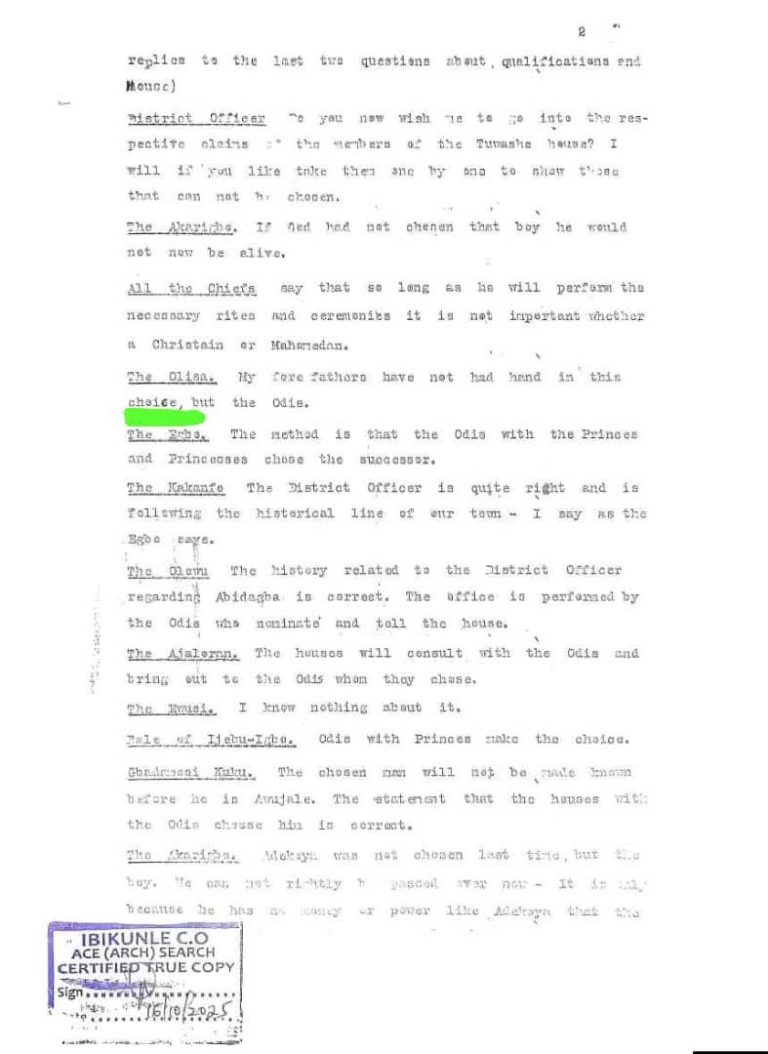
1. What the Olisa Actually Said in 1925
The authentic testimony reads:
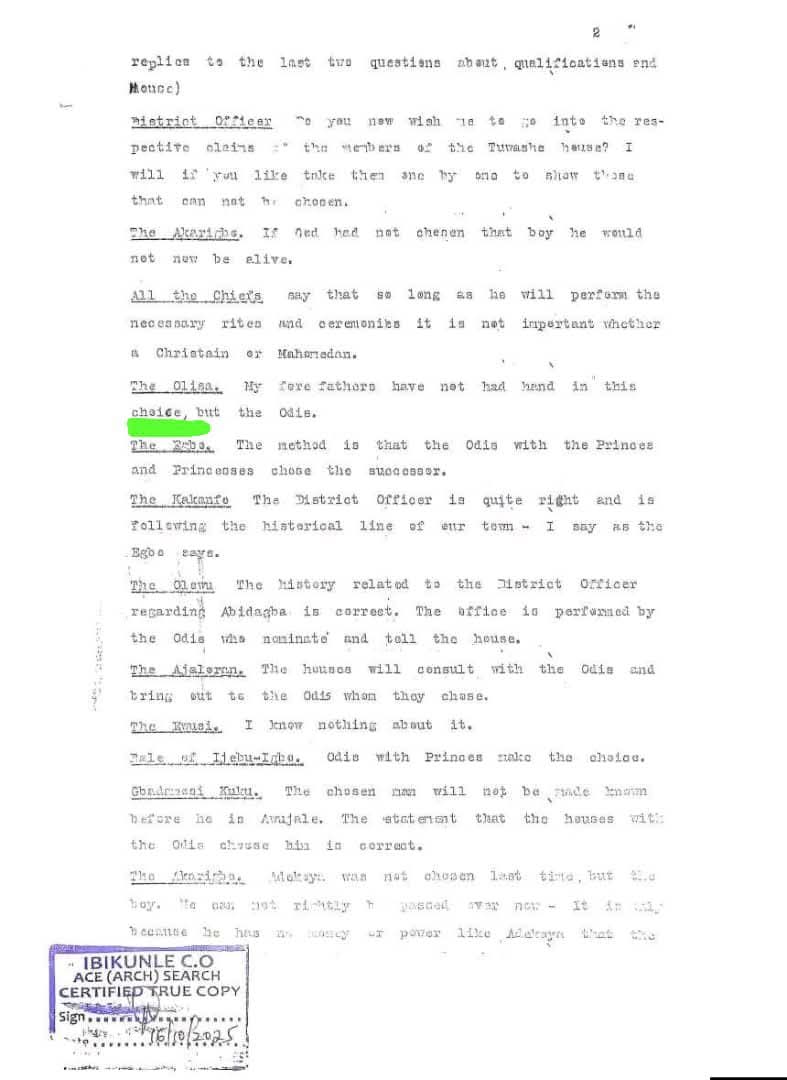
“My forefathers have not had hand in the choosing of the Awujale, but the Odis.”
This is not a surrender of role. It is a precise description of division of labour in Ijebu customary law.
In 1920s Ijebu usage:
– “Choosing” = Identifying and nominating one or more candidates. This responsibility belongs to the family and the Odi, who are attached to the Awujale’s palace, understand the lineage, and witness the upbringing of the children.
– “Selecting” = Ratifying, affirming, and presenting the candidate to the town and government. This is the joint act of the kingmakers, headed by the Olisa of Ijebu-Ode.
So when the Olisa said his forefathers had no hand in choosing, he was acknowledging that the family and Odi, by virtue of knowing and understanding their lineage while the proximity of the Odi to the palace, are best placed to know the candidates. He was not saying the Olisa or the ruling houses have no role in selection.
To quote him as saying he has no right to “choose or select” is to misquote him against the record he helped create.
2. The Same Record Confirms the Two-Step Process
The 1925 minutes do not stand alone. Other chiefs in the same session confirmed the process:
– Olowu: “The office is performed by the Odis who nominate and tell the house.” The Odi nominate. The house is consulted.
– Ajalorun: “The houses will consult with the Odis and bring out to the Odis whom they choose.” The houses present a candidate after internal consultation.
– Gbadamosi Kuku: “The statement that the houses with the Odis choose him is correct.” The final act is joint.
– All the Chiefs: “So long as he will perform the necessary rites… religion not important.” The test is ritual competence, not who spoke first.
Deduction: The process has two legs. The Odi and family CHOOSE. The houses consult. The kingmakers, headed by the Olisa, SELECT, approves and forward to government for consent.
3. Why the Odi’s Role in Choosing Makes Sense
Custom gave the Odi this responsibility for a reason. They are attached to the Awujale’s palace. They see the candidates grow up. They know character, conduct, and capacity.
The Olisa, as head of the Ilamuren class and the kingmakers, ensures that the process is completed properly: consultation with the houses, performance of rites, and final selection in line with the 1957 Chieftaincy Declaration and subsequent instruments.
This is not a rivalry. It is a constitutional balance. One leg initiates. The other ratifies. Remove one, and the stool becomes unstable.
4. Why the Distortion Is Dangerous
The claim that “the Olisa said he is not entitled to choose and not to select” does three things:
1. It misrepresents the record.
The Olisa never said he has no role in selection. He only said his forefathers did not initiate the choosing. To collapse both steps is to mislead.
2. It erases the constitutional role of the Olisa.
The 1957 Declaration and subsequent gazettes and judgments recognize the Olisa as head of the kingmakers. Saying he has no role in selection sets up false legal arguments and confuses young Ijebus reading online.
3. It reveals the motive.
This twist appears only when a succession process is underway and a preferred candidate needs a cleared path. It is not scholarship. It is blackmail by proxy, designed to erase the Olisa’s role to suit a personal interest.
5. The Correct Position, From the Record Itself
1. Choosing = Odi and the family. They nominate based on knowledge of lineage and conduct.
2. Consultation = Ruling houses consult with the Odi and present candidates.
3. Selection = Kingmakers, headed by the Olisa, affirm, ratify, and present to the government for consent.
4. Consent = Government confirms the selection.
5. Rites = The candidate must be able to perform traditional duties. Religion is secondary to ritual competence.
This is the tripod. Odi. Ruling houses. Kingmakers headed by the Olisa. Remove one leg, and the stool cannot stand.
6. A Note to Ijebus at Home and Abroad
History is not “how it ought to be.” History is “how it was.” And the record is clear. The Olisa never disqualified himself from selection. He only described the division of labour in choosing.
To those circulating the distorted version: stop playing on the intelligence of Ijebus. If you want to argue the stool, use the whole transcript, not one clause taken out of context. Customary law is read in full.
The Olisa’s role stands. It stands in the 1925 testimony, in the 1957 Declaration, and in the gazettes and judgments that followed. No amount of “cho cho” can erase that.
Culture & Law | Ijebu Kingdom Monday, May 11, 2026 | Ijebu-Ode
©️The Truth magazine.
@highlight
#followers
#ijebu
#ogunstate.
About the Author